
Direct Recruitment vs Referral Hiring: Which Delivers Better Hires for Small Businesses in Australia
Worried about which delivers better hires? Get real answers on direct recruitment vs referral hiring and finding the right people.
 Life Ocampo
Referral hiring generally delivers higher retention for small businesses than traditional recruitment tactics. Referred workers are 10–30% less likely to quit than non-referred workers, according to research published in the Quarterly Journal of Economics.
If you’re a small business owner in Australia, every hire matters. The big question isn’t just “Can we fill the role?” but “Will this person stay, perform, and fit our culture?” That’s where the direct recruitment vs referral hiring debate gets real.
Key Takeaways
- Employee referrals yield 10–30% lower turnover and 45% longer retention over four years.
- Referrals cut time-to-hire significantly, saving costs compared to the $23,860 AUD average Australian benchmark.
- Direct recruitment, whether managed internally or through dedicated partners like Empire People, remains essential for executive leadership and improving team diversity.
Direct Recruitment vs Referral Hiring: At a Glance
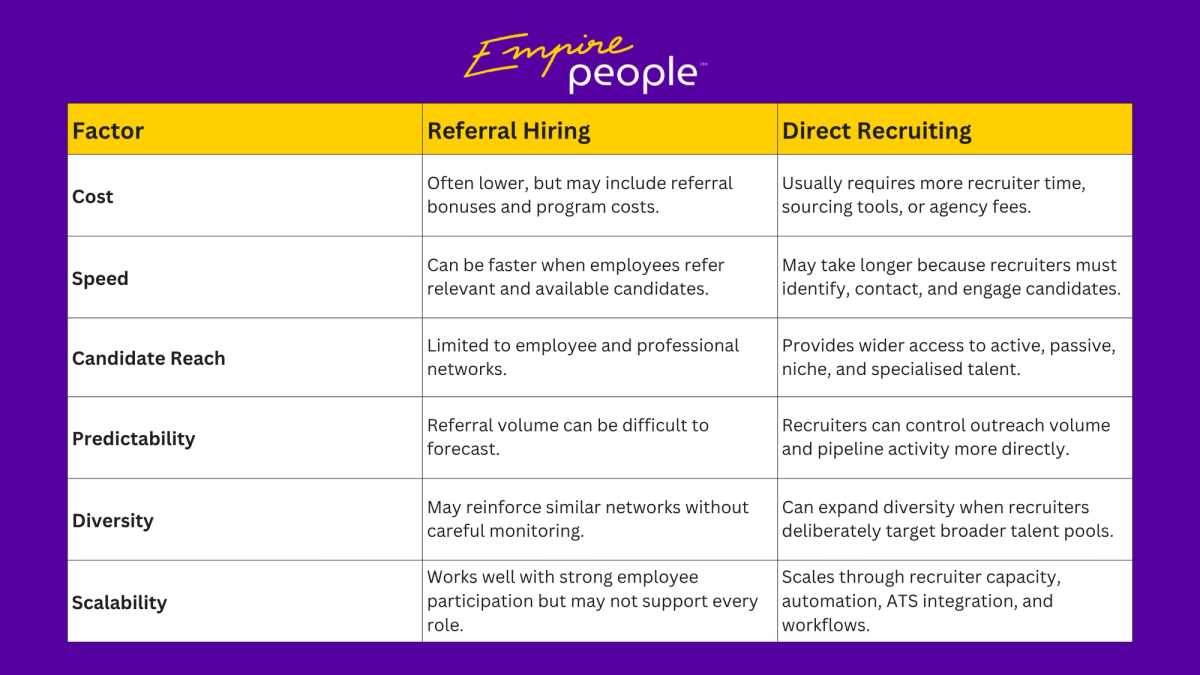
How Direct Recruitment Works
Direct recruitment means you source, screen, and hire candidates without relying on employee referrals, either via internal human resources (HR) or recruiters, or by engaging external agencies. While some businesses attempt this in-house, most go for expert recruitment providers like Empire People to handle this process.
According to the Australian HR Institute (AHRI), the average cost to hire across all roles in Australia is $23,860, factoring in advertising, screening, interviews, onboarding, and lost productivity.
Common methods for Australian small businesses include:
How Referral-Based Hiring Works
Referral-based hiring leverages your existing team to recommend candidates from their networks, often supported by a formal program with clear rules and incentives.
According to a 2022 Aptitude Research report, 60% of companies reduced their average time to hire for referred candidates who were hired in the last few years.
The referral-based hiring process includes:
- Job Announcement: The open role is shared internally alongside details regarding candidate requirements and employee referral rewards.
- Employee Submission: Staff members introduce pre-vetted colleagues or past contacts who match the profile.
- Fast-Tracked Evaluation: Referred candidates enter the interview process quickly due to the built-in peer recommendation.
- Reward Distribution: Once the referred candidate completes a probation period (typically 3 to 6 months), the referring employee receives their monetary bonus.
How Empire People Works
Empire People brings hiring, HR, and compliance into streamlined people management. Rather than managing multiple providers and disconnected tools, EmpireOne members can build high-performing teams through one platform.
Rather than functioning like traditional agencies that push high volumes of resumes to hit quotas, we spend the time necessary to deeply understand your culture and role requirements, so you get the right candidate, not just any candidate.
Why Employee Referrals Last Longer
Employee referrals last longer because they combine pre-vetted capability with stronger cultural alignment and social accountability. This comes from three factors: current employees understand the role and culture, candidates receive realistic previews via their referrer, and both parties have reputational stakes in the outcome.
The data is consistent. Referred candidates stay longer.
Industry research shows that recruiters look to employee referrals for stability and growth.
- Employee referrals produced 16.8% of hires from only 1.6% of applications. (Source: Gem’s 2026 Recruiting Benchmarks Report)
- 45% of referred hires remain with a company for more than four years. (Source: Employee Referral)
- 88% of employers rank employee referrals as their best source of quality candidates. (Source: CareerBuilder)
Frequently Asked Questions
Are employee referrals better than using a recruiter?
It depends on your team's network and current hiring needs. While employee referrals work well for roles where your staff has strong contacts, relying solely on them can limit your reach. Partnering with a quality-focused recruitment provider like Empire People ensures you access qualified passive candidates who fit your culture.
Can small businesses rely on referral-based hiring?
Yes, small businesses can effectively leverage referral-based hiring, but it shouldn't be their only sourcing method. Because smaller teams have smaller personal networks, referral channels can eventually run dry.
Reduce Turnover and Build a Team That Lasts
Referrals are strong for speed, retention, and cost control. Direct recruiting is essential for senior or diversity-focused hires. The goal is to build a stable and high-performing team that grows with you.
While referrals offer speed and built-in trust, strategic recruitment through Empire People opens doors to a much broader and highly targeted talent pool, ensuring you secure team members who perform, fit your culture, and stay long-term.
Create an account today to download our New Hire Checklist for Managers and streamline your onboarding process.
Related Reading: